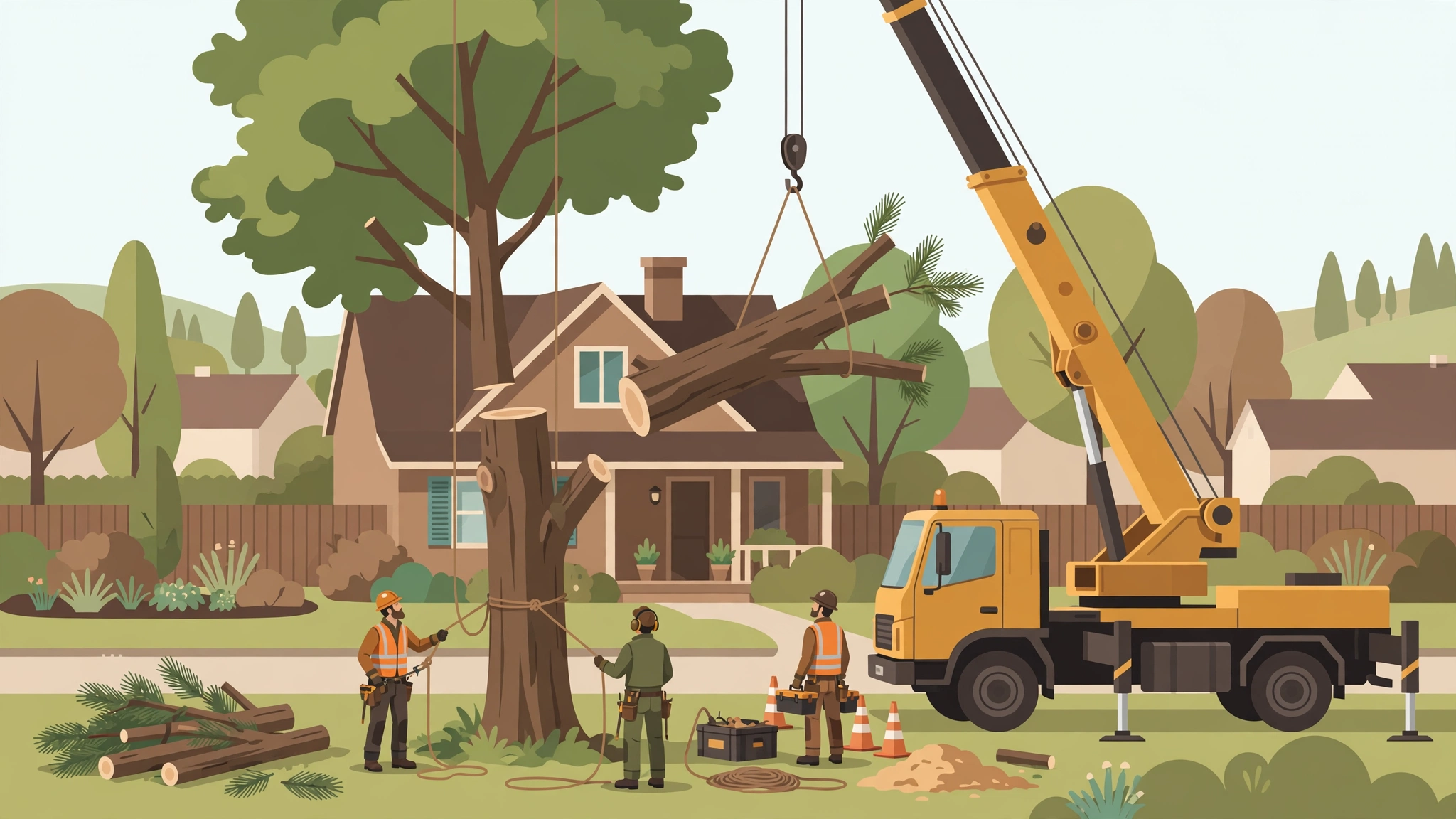
How Much Does Tree Removal Cost?
How much does tree removal cost? In the United States, most homeowners pay $450 to $1,450 for a standard tree removal, according to Thumbtack in March 2026, while Angi puts the average tree removal cost at $750 in October 2026, with most jobs between $200 and $2,000. Your final tree removal price depends on the size of the tree, the condition of the tree, and the location of the tree.
This guide compares five recent cost guides published in 2025 and 2026, including Angi, Thumbtack, Amplify Credit Union, Austin Tree Amigos and We Love Trees, and it uses price figures only from those compared sources, with the source and year named each time. Prices vary by region, and the figures here are US averages, not a quote for your yard, so treat them as a starting budget. A small tree in an open yard can be a few hundred dollars, while a very large tree near a house or power lines can cost several thousand dollars once stump grinding, debris hauling and a permit fee are added.
Table of Contents
How Much Does Tree Removal Cost by Tree Size?
Tree size is the first thing a tree service company asks about, because it drives the labor, equipment and time on site. Most guides split trees by tree height, and some also use trunk diameter, measured as diameter at breast height, which is the width of the trunk about four and a half feet above the ground. A tall tree with a wide trunk and a broad canopy takes longer to cut, needs more rigging, and produces more branches and trunk wood to haul away. Two trees of the same height can have very different tree removal prices if one is a dense hardwood and the other is a lighter softwood.
Angi, in October 2026, groups trees in four bands: up to 30 feet, 30 to 60 feet, 60 to 80 feet, and over 80 feet. Amplify Credit Union, in January 2025, uses a simpler split: a small tree under 30 feet, a medium tree from 30 to 60 feet, and a tall tree over 60 feet. Thumbtack, in March 2026, adds trunk diameter and canopy width to height. Tree cutting starts with felling, then cutting the tree into sections, and the tree removal service should explain which method it will use. The table below brings those guides together.
| Tree size | Height | Typical cost range | Source |
|---|---|---|---|
| Small tree | Under 30 ft | $150 to $500 | Amplify, Jan 2025 (Angi, Oct 2026: $150 to $450) |
| Medium tree | 30 to 60 ft | $450 to $1,200 | Angi, Oct 2026 |
| Large tree | 60 to 80 ft | $800 to $1,500 | Angi, Oct 2026 |
| Very large tree | Over 80 ft | $1,000 to $2,000 | Angi, Oct 2026 |
A small tree is usually a young or short tree, often a pine tree or a small palm tree, in a front yard or backyard with clear access. Angi puts a tree up to 30 feet at $150 to $450 in October 2026, and Amplify puts a small tree under 30 feet at $150 to $500 in January 2025, so the two sources agree at the low end. Thumbtack, in March 2026, adds trunk size: a tree under 12 inches across, with a canopy under 30 feet, costs $226 to $596. If the tree is in an open yard, with no fence, roof or driveway in the way, the crew can often fell it in one piece, which keeps labor costs down.
A medium tree is the most common job a homeowner faces. Angi, in October 2026, puts a medium tree of 30 to 60 feet at $450 to $1,200, and Amplify, in January 2025, puts the same band at $500 to $1,000. A medium oak tree or pine tree usually has a trunk 12 to 24 inches across, a canopy over a garden bed or driveway, and a modest root system. A large tree is 60 to 80 feet tall, and Angi puts it at $800 to $1,500 in October 2026. A very large tree over 80 feet costs $1,000 to $2,000 in the same guide, but that is a starting point, because a very large tree in a tight spot can cost far more.
What Drives Tree Removal Prices Up?
Once you know the size band, the next question is what else pushes the price up. The cost factors below appear in almost every 2025 and 2026 guide. Height of the tree, trunk diameter, tree condition, tree location and accessibility all move the price, and two or three together can move it a lot. A healthy tree in an open yard is the cheapest job, while a dead tree close to the house, over power lines, on a slope, with difficult access, is the most expensive kind. A dead or leaning tree can also lower property value and curb appeal.
Height, trunk diameter and location
Tree height and trunk diameter work together. A taller tree means more cutting, more lowering and more wood to haul away, and a thicker trunk means a longer cut with a larger chainsaw. Thumbtack, in March 2026, shows this clearly: a tree 12 to 24 inches across, with a canopy under 30 feet, costs $517 to $1,364, while a tree 24 to 36 inches across, with a canopy over 30 feet, costs $1,562 to $4,117. Tree location is often the next biggest driver. A tree near a house, close to the house, over a roof, or beside power lines has to be taken down in sections, often with a crane. Angi, in October 2026, says a large tree near power lines can cost up to $10,000 or more, and that difficult access can add 25 to 50 percent to the price.
Condition, emergency work and access
The condition of the tree changes both the risk and the method. A healthy tree is predictable, a leaning tree is less so, and a dead tree or a diseased tree can have weak branches, hollow wood or a root system that is no longer holding firmly. Angi, in October 2026, says a tree in poor health can cost up to 15 percent more to remove. A storm-damaged tree that is split, hung up in another tree or resting on a roof is an emergency job. Amplify, in January 2025, puts emergency tree removal at $500 to $2,500, Angi, in October 2026, puts emergency work up to $5,000, and We Love Trees, in March 2026, adds a 40 percent premium for emergency work in Austin. Storm damage and falling branches are safety risks, so a homeowner should not wait for a bad tree to fall. Tree trimming and pruning are tree care jobs on a slope with tight access, and a bucket truck in winter or spring adds equipment costs, so check for extra fees.
What Extra Charges Should You Expect?
Stump removal and stump grinding are the most common extras, and they are priced in different ways. Stump removal usually means digging out the whole stump and roots, while stump grinding means grinding the stump down below ground level. A homeowner who plans replanting or landscaping in the same spot will usually want the stump ground. If you plan to fill the hole and replant, our guide on how much topsoil do I need can help, and the Topsoil Calculator can check the amount.
| Extra service | Typical extra charge | Source |
|---|---|---|
| Stump removal | $100 to $150 | Angi, Oct 2026 |
| Stump grinding | $60 to $350 | Amplify, Jan 2025 |
| Debris removal and hauling | $300 to $600 extra with some companies | We Love Trees, Mar 2026 |
| Wood chipping | $150 to $250 for two hours | Angi, Oct 2026 |
| Permit | $60 to $150 | Angi, Oct 2026 |
| Emergency call-out | $500 to $2,500 | Amplify, Jan 2025 |
Stump work is a good example of why two prices can both be correct. Angi, in October 2026, puts stump removal at $100 to $150 for a first stump, with $50 for each additional stump, while Amplify, in January 2025, puts stump grinding at $60 to $350, and We Love Trees, in March 2026, puts it at $150 to $500, or $3 to $5 per inch of trunk diameter. Thumbtack, in March 2026, puts stump grinding at $267 to $354 for a small stump, $324 to $443 for a medium stump, and $355 to $486 for a large stump. Bundling it with the removal is usually cheaper than booking it later.
How Can You Check Your Estimate With a Calculator?
If you are asking how much does tree removal cost for a tree like yours, a calculator can give you a quick sanity check. Try the Tree Removal Cost Calculator with your tree height, trunk diameter, tree species, condition and access. It uses United States pricing, and lets you choose cutting only, full removal or complete cleanup, with stump grinding and a permit fee as options.
As a worked example, I tried it with one softwood, a medium tree of 30 to 60 feet, a medium trunk of 12 to 24 inches, a healthy tree in an open yard, and full removal. The calculator gave $640 to $1,000, with a typical cost of about $820. Cutting only gave $384 to $600, and complete cleanup gave $840 to $1,300. Those figures line up with Angi, October 2026, at $450 to $1,200 for a medium tree, and Amplify, January 2025, at $500 to $1,000. The calculator is an estimate, not a quote, and the final price will depend on local prices and local labor rates. Texas, California and Florida price ranges differ.
How Do You Get a Fair Quote?
Get multiple quotes, and aim for three quotes from three different tree removal companies, all for the same work, on the same tree, in the same yard. That gives you a price range for your job, not just a national average, and shows whether one company is far above or far below the others. A fair quote is not always the lowest price, and a fair price covers licensed workers, safety equipment, insurance, disposal fees and proper cleanup.
Check the company before you check the price. A licensed company should show that it is licensed and insured, with liability insurance and workers’ compensation, and a certified arborist on staff is a good sign. Ask for a certificate of insurance, and check that it is current, because a homeowner can be left with property damage if an uninsured crew damages a roof or fence. Homeowners insurance may help if a tree falls on a house, but it does not usually pay for a planned removal. A professional tree removal company will visit in person, look at the tree, roots, canopy and access, and give you a written estimate.
- Get three quotes for the same service, including stump grinding, debris removal and permits, so you can compare quotes like with like.
- Ask each company for a free estimate in person, listing the tree, the service and what is included.
- Ask whether stump removal, debris hauling, wood chipping, cleanup and a permit are included.
- Check reviews, a certified arborist, and a certificate of insurance before you agree.
- Get the final price in a written quote, with the service, dates and payment terms named.
- Ask about off-season dates, and whether removing more than one tree lowers the per-tree price.
Be careful with a quote far below the others, and with a company that asks for full payment in advance. A fair quote will usually ask for a deposit, or payment on completion. Ask how long the job will take, what happens to the wood and the mulch, whether you can keep firewood, and how the crew will protect your garden, lawn, driveway and neighbour’s property. If you pay by card, the Credit Card Interest Calculator can show the cost if you carry a balance, and our guide on how much you need to retire can help with the wider budget. After the tree is gone, the Tile Calculator can help with a new patio, the water efficiency tracker can help with watering a new garden, and our guide on how to save water has simple ways to cut water use. Find more guides in the Daily Life Blog, and more calculators on the Daily Life Calculators home page.
Frequently Asked Questions About Tree Removal Costs
How much does it cost to remove a small tree?
A small tree under 30 feet usually costs $150 to $500, according to Amplify in January 2025, and $150 to $450, according to Angi in October 2026. The final price depends on trunk diameter, tree condition and access, and a small tree near a house or power lines can cost more than a larger tree in an open yard. Stump grinding is usually extra, at $60 to $350 in Amplify, January 2025.
Does homeowners insurance cover tree removal?
Homeowners insurance usually covers tree removal only if a tree falls on a house, a fence or another covered structure, or blocks a driveway, after storm damage or another covered event. It does not usually pay for a planned removal of a healthy tree, a dead tree or a diseased tree. Check your policy and talk to your insurer before you book.
Is stump removal included in the price?
Not usually. A standard full removal often covers cutting and haul away, but not stump removal or stump grinding. Angi, in October 2026, puts stump removal at $100 to $150, and Amplify, in January 2025, puts stump grinding at $60 to $350. Ask the company to list stump work in the written quote, and ask whether it includes filling the hole and clearing the roots, because a left stump can get in the way of replanting and landscaping.
Do I need a permit to remove a tree?
It depends on your city and the tree. Some areas need no permit for a small tree on private land, while others need a tree removal permit for a large or protected tree. In Austin, for example, a permit is needed for a tree 19 inches or larger, according to We Love Trees in March 2026. Angi, in October 2026, puts a permit at $60 to $150, and rules vary by region. Ask your city, and ask the tree service company whether it will handle the permit.
Can I remove a tree myself to save money?
A DIY tree removal can be dangerous, and it is not a good way to save money on a medium or large tree. Amplify, in January 2025, warns that do it yourself removal can damage a house, a fence or power lines, and that a fall can cause serious injury. We Love Trees, in March 2026, notes that renting a chainsaw can cost $85 a day, a wood chipper $300 a day, and disposal $50 per ton. For a tree near a house, a leaning tree or a dead tree, a licensed and insured professional is the safer choice.
Disclaimer: This article is for general information only, and the prices are US averages from the sources and years named above. Prices vary by region, tree and company, and they are not a quote for your property. Get a written estimate from a licensed and insured tree removal company in your area before you decide, and check local permit rules. Read our Disclaimer for more information.